

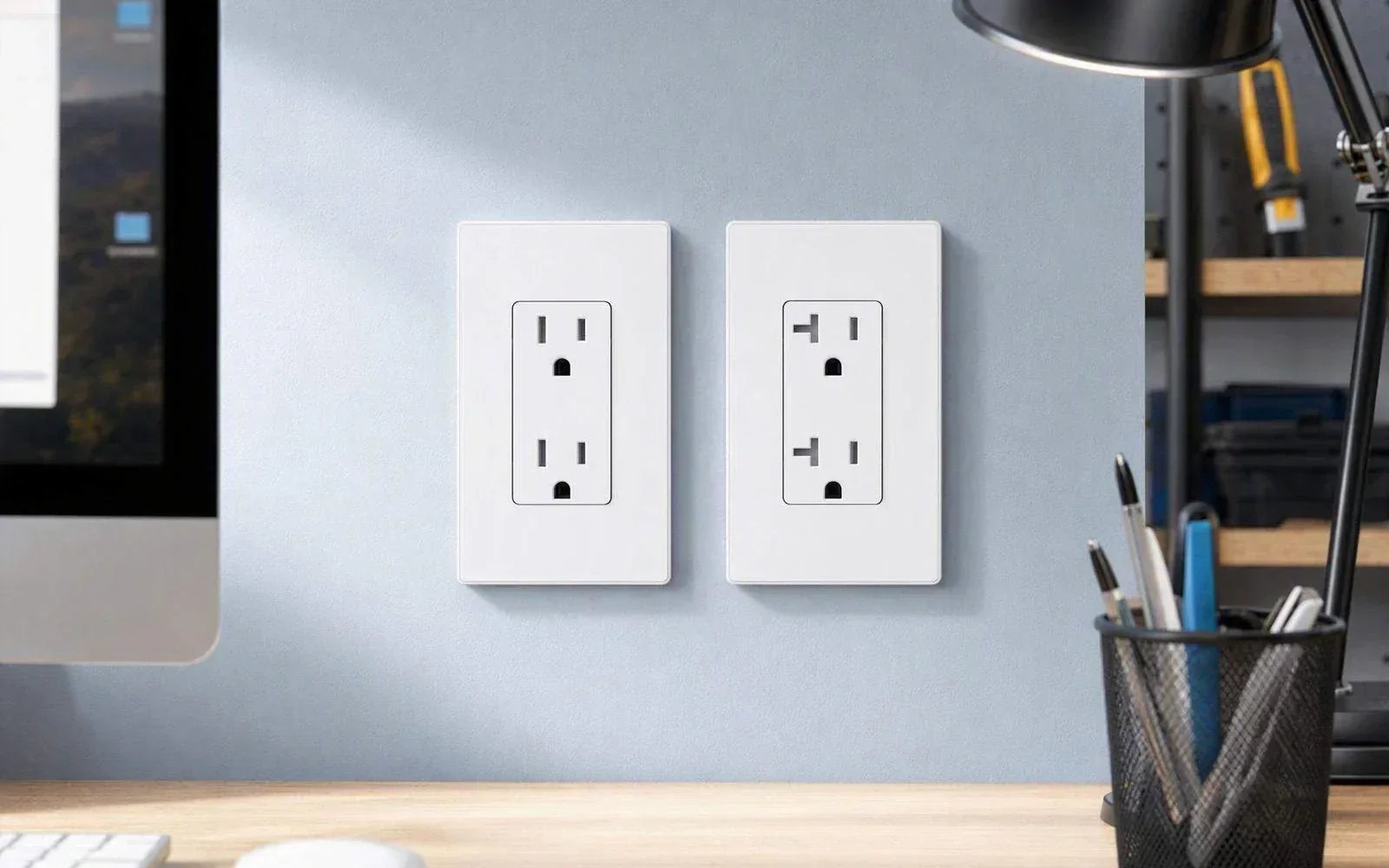
Electrical Outlet vs. Receptacle: What Do These Terms Mean?

Quick answer
In everyday speech, people use outlet and receptacle for the same thing: the device in the wall you plug into. The National Electrical Code (NEC) draws a sharper line. An outlet is any point on the wiring system where current is taken to supply equipment. A receptacle is the contact device installed at that point so an attachment plug can connect. Every receptacle sits at an outlet, but a hardwired light or a smoke detector is an outlet too, so not every outlet holds a receptacle. [2]
For anyone replacing a wall device, the exact word matters far less than the match. A good replacement comes down to five checks: amperage, the NEMA slot pattern, voltage, the wiring method, and whether the device fits the box. This article explains where the terms come from and gives you a checklist to run before you buy.
Why the two words get mixed up
The difference between an outlet and a receptacle is easy to explain once you separate two habits of speech.
In plain English, an outlet is "the place I plug things in." That is how people talk at home, and home-improvement stores follow the same habit because it matches how shoppers search. Almost nobody walks into a store asking for a "contact device." They ask for a wall outlet, a USB outlet, or a kitchen outlet.
The NEC and the people who work with it use more exact language, because in the code the two words point to different things: one is a location on the circuit, the other is a piece of hardware installed there. That gap is why a package can say "duplex receptacle" on the front while the online title reads "USB wall outlet." Both are describing the same product; they are just using different registers of the same vocabulary.
For replacement shopping, treat the label as a conversational shortcut and move your attention to the specifications. A wall device can be the right category and still be the wrong fit for your circuit, your box, or your wiring method.
What the NEC actually says
The NEC gives both terms a formal definition in Article 100, the section that sets the vocabulary for the rest of the code. [2]
| Term | NEC meaning (paraphrased) | What it points to |
|---|---|---|
| Outlet | A point on the wiring system where current is taken to supply equipment | A location on the circuit |
| Receptacle | A contact device installed at the outlet for the connection of an attachment plug | The hardware you plug into |
| Single receptacle | One contact device with no other on the same yoke or strap | A single plug-in position |
| Duplex (multiple) receptacle | Two or more contact devices on the same yoke or strap | The familiar two-position wall device |
Single and duplex are the basic types of receptacles, sorted by how many plug-in positions share one yoke. That last row explains the everyday picture: when most people say "an outlet," they usually mean a duplex receptacle, one device with two plug-in faces on a single yoke. A tamper-resistant version and a USB-charging version are still receptacles; they just add features to the same in-wall footprint.
What a receptacle includes in a typical wall installation
With the terms sorted out, it helps to see the hardware they describe. Remove the cover plate from a standard wall device and the parts get easy to name.
- The face is the front, where the slots and grounding opening appear. On a grounded residential device, two vertical slots accept the plug blades and the round or U-shaped opening accepts the grounding pin.
- The body and yoke sit behind the face. The metal mounting strap (yoke) screws into the wall box and holds the device in place.
- The terminals are where the conductors connect. Many residential devices offer side wiring with terminal screws, and some also support back wiring, which can make the install easier depending on the box and conductor layout.
- The cover plate finishes the opening in the wall. It is a separate part, so it is not the receptacle itself.
Two of these matter most during a replacement. The terminals decide how your existing conductors connect to the new device, and the depth of the body decides whether it seats cleanly in your box. A device with extra internal hardware sits deeper, which becomes a real issue in shallow or crowded boxes.

NEMA patterns: how 5-15R and 5-20R differ
NEMA names tell you the plug pattern a receptacle accepts, and this is where terminology turns into a genuine compatibility question.
| Feature | NEMA 5-15R | NEMA 5-20R |
|---|---|---|
| Rating | 15 A, 125 V | 20 A, 125 V |
| Face | Two straight parallel slots plus a grounding hole | One slot adds a horizontal notch, forming a "T" on the neutral side |
| Typical use | The standard wall outlet in most North American homes | Circuits feeding higher-draw equipment |
| Safe delivery at 125 V | Up to about 1,875 W | Up to about 2,500 W |
The two patterns are related by design. A standard 15-amp plug fits into a 20-amp receptacle, so common household electronics work in either. A 20-amp plug, with its sideways blade, physically will not fit a 15-amp receptacle. [3] The T-shaped slot is the visual cue: if the neutral slot has that horizontal notch, you are looking at a 20-amp device.
This is the practical reason to read the amperage and slot shape before buying. Matching the receptacle to the circuit and breaker is a safety requirement.

Tamper resistance and safety listings
Two label terms carry real weight, and both are rooted in safety requirements.
Tamper-resistant (TR). A TR receptacle has internal shutters that stay closed unless equal pressure is applied to both slots at once, which resists insertion of foreign objects. This is now a code requirement in many living spaces: the NEC calls for listed tamper-resistant receptacles for 15- and 20-ampere, 125- and 250-volt nonlocking receptacles in the areas it specifies, such as dwelling-unit rooms. [5] If you are replacing devices in bedrooms, family rooms, or similar spaces, a TR device is usually what the current code expects.
UL listed. A "UL listed" marking means the product has been evaluated to the applicable safety standard for receptacles by UL Solutions. [4] For a replacement device, that listing tells you more about basic safety than any product nickname on the box. A limited warranty is a separate thing; it is useful, but it is not a safety evaluation.
How USB and smart models widened what people mean by "outlet"
Everything so far describes a plain receptacle. Modern in-wall hardware adds more to the same box, and that is what stretched the word "outlet" in everyday use.
A USB-charging receptacle — often sold as a USB wall outlet or a wall outlet with a USB port — adds charging ports to the same footprint, so one device both accepts plugs and charges phones or tablets directly. That is why many homeowners started using "outlet" for a wider category of powered wall hardware. Smart in-wall receptacles push the language further, adding app or voice control and, on some models, independent control of the top and bottom positions. When someone calls that a "smart outlet," everyday conversation is on their side, even though the hardware is still a receptacle.
The shift is practical. People name products by what they do, so once a wall device charges a phone or responds to an app, the plain-device vocabulary starts to feel narrow. Brands that make wall devices, such as Elegrp, now offer both USB-charging and smart in-wall receptacles alongside standard ones. [1] The technical distinction still governs the install; the everyday wording simply followed the hardware.
When the difference matters most during replacement
That everyday wording stops being an academic point the moment you match a new device to an existing circuit.
Amperage comes first. If the branch circuit is 15 amps, you need a receptacle suited to that circuit and its breaker; if it is 20 amps, the pattern and rating matter even more. Voltage is usually the simple part in a standard U.S. room, because ordinary residential receptacles are commonly 125 V. The harder question is which of the three devices above you are actually installing: a plain receptacle, a USB-charging receptacle, or a smart in-wall model. The word "outlet" alone leaves that open; the specification set answers it.
Device depth is the next thing to settle. As noted earlier, anything with built-in charging or smart hardware sits deeper in the box, so a model can be correct electrically and still be awkward to seat if the box is shallow or the conductors are stiff. Check the dimensions against your box for any device beyond the basic one.
Included accessories affect how the job goes, too. A screwless wall plate in the box saves a separate purchase and gives a cleaner finish. Back-and-side wiring options can turn an awkward install in a tight box into a straightforward one.
A compatibility checklist before you buy
The reliable way to shop is to ignore the casual label and verify the same details every time. Whether the listing says wall outlet, receptacle, or USB outlet, run through this before you buy.
| What to check | Why it matters | Typical residential value | Where to confirm it |
|---|---|---|---|
| Amperage | The device must suit the circuit and its breaker | 15 A or 20 A | Device label, listing, existing circuit |
| Voltage | Confirms it is meant for a standard branch circuit | 125 V | Product specifications |
| NEMA pattern | Tells you which plug configuration it accepts | 5-15R or 5-20R | Product title, spec sheet, face shape |
| Box depth | Deeper USB or smart models are harder to seat | Varies; deeper devices need more room | Product dimensions plus a look at your box |
| Wiring method | Determines how conductors connect | Back wire or side wire | Installation details or instructions |
| Tamper resistance | Required by code in many living spaces | Listed TR shutters | Front label or spec list |
| Safety listing | Confirms evaluation to a recognized standard | UL listed | Packaging, molded markings, listing |
| USB port mix | Affects what you can charge without an adapter | USB-C, USB-A, or both | Product title and port layout |
| Wall plate included | Saves a separate purchase | Included on some models | Box contents or listing |
This checklist prevents the most common mistake: buying by nickname when the fit is what counts. Confirm the amperage first, then the voltage, then the NEMA pattern, then the physical fit.
How to read a product label without getting tripped up
The quickest way to decode a listing is to treat the front label as shorthand and the specification block as the real description.
- Wall outlet usually signals everyday language; check the specs to see what it actually is.
- USB receptacle tells you the device includes charging ports.
- Duplex receptacle means two plug-in positions on one device.
- Tamper-resistant receptacle tells you it has internal shutters.
- Smart in-wall outlet usually means a receptacle with wireless control.
Once you shop by the specification set, the wording fades into the background. Read the rating, the receptacle pattern, the wiring options, the dimensions, and the safety listing, and the label stops being a source of confusion.
FAQ
Is every outlet a receptacle?
No. In the NEC, an outlet is any point on the wiring system where current is taken to supply equipment, and a receptacle is one type of device installed at that point. A hardwired light fixture connects at an outlet but has no receptacle. Every receptacle sits at an outlet, so the relationship runs one way. In everyday home use, people say "outlet" when they mean the receptacle in the wall, which is a common shortcut even though it is looser than the code term.
What is a duplex receptacle?
A duplex receptacle is one installed device with two contact positions on the same yoke or strap. It is the standard wall device most people picture in a bedroom, office, or living room. If you see two places to plug in cords on a single face, you are looking at a duplex receptacle.
Does a USB wall outlet replace a standard receptacle?
Yes. A USB wall outlet is a replacement receptacle that fits the wall box in place of a standard device while adding built-in charging ports. The nickname is not the deciding factor; what matters is whether the replacement matches the circuit rating, the voltage, the wiring method, and the available box depth.
What does 15A/20A mean on a replacement device?
It refers to the amperage the receptacle is designed to support in the right application. In residential shopping, 15 A and 20 A are the common ratings. A 15-amp plug fits a 20-amp receptacle, but a 20-amp plug will not fit a 15-amp one, so you should match the device to the circuit and breaker already in place rather than assume any wall device will do.
How many amps are in a wall outlet?
A standard wall outlet in a North American home is almost always a 15-amp or 20-amp receptacle at 125 volts. A 15-amp circuit can safely deliver up to about 1,875 watts, and a 20-amp circuit up to about 2,500 watts. You can tell the two apart by the face: the 20-amp version (NEMA 5-20R) adds a small horizontal notch to one slot, forming a "T," while the 15-amp version (NEMA 5-15R) has two straight parallel slots.
Why does box depth matter for USB or smart models?
USB charging and smart control add internal hardware, so those devices sit deeper in the box. A deeper device can be correct electrically and still be hard to fold into a shallow or crowded box. Checking the product dimensions against your existing box before buying saves a frustrating install, which is why depth belongs on the checklist.
Do I need a tamper-resistant receptacle?
In many living spaces, yes. The NEC requires listed tamper-resistant receptacles for 15- and 20-ampere, 125- and 250-volt nonlocking receptacles in the areas it specifies, including dwelling-unit rooms. [5] If you are replacing devices in a home, a TR model is usually what the current code expects, so it is a safe default when in doubt.
Bottom line
In everyday speech, "electrical outlet" usually means the wall device you plug into, while the more exact hardware term is "receptacle." The distinction matters most during a replacement, because a good swap depends less on the label and more on matching the amperage, voltage, NEMA pattern, safety listing, wiring method, and box fit.
If you remember one rule, make it this: shop by specifications, not by nickname. The wording on the package can be casual, but the device in your wall has to match the existing circuit and physical space exactly.
References
- Elegrp Official Website
- National Electrical Code (NFPA 70), Article 100 — definitions of "outlet" and "receptacle" (NFPA free access)
- NEMA WD 6, Wiring Devices — Dimensional Specifications (straight-blade configurations NEMA 5-15R and 5-20R)
- UL 498, Standard for Attachment Plugs and Receptacles — UL Solutions
- National Electrical Code (NFPA 70), Section 406.12, Tamper-Resistant Receptacles (NFPA free access)


